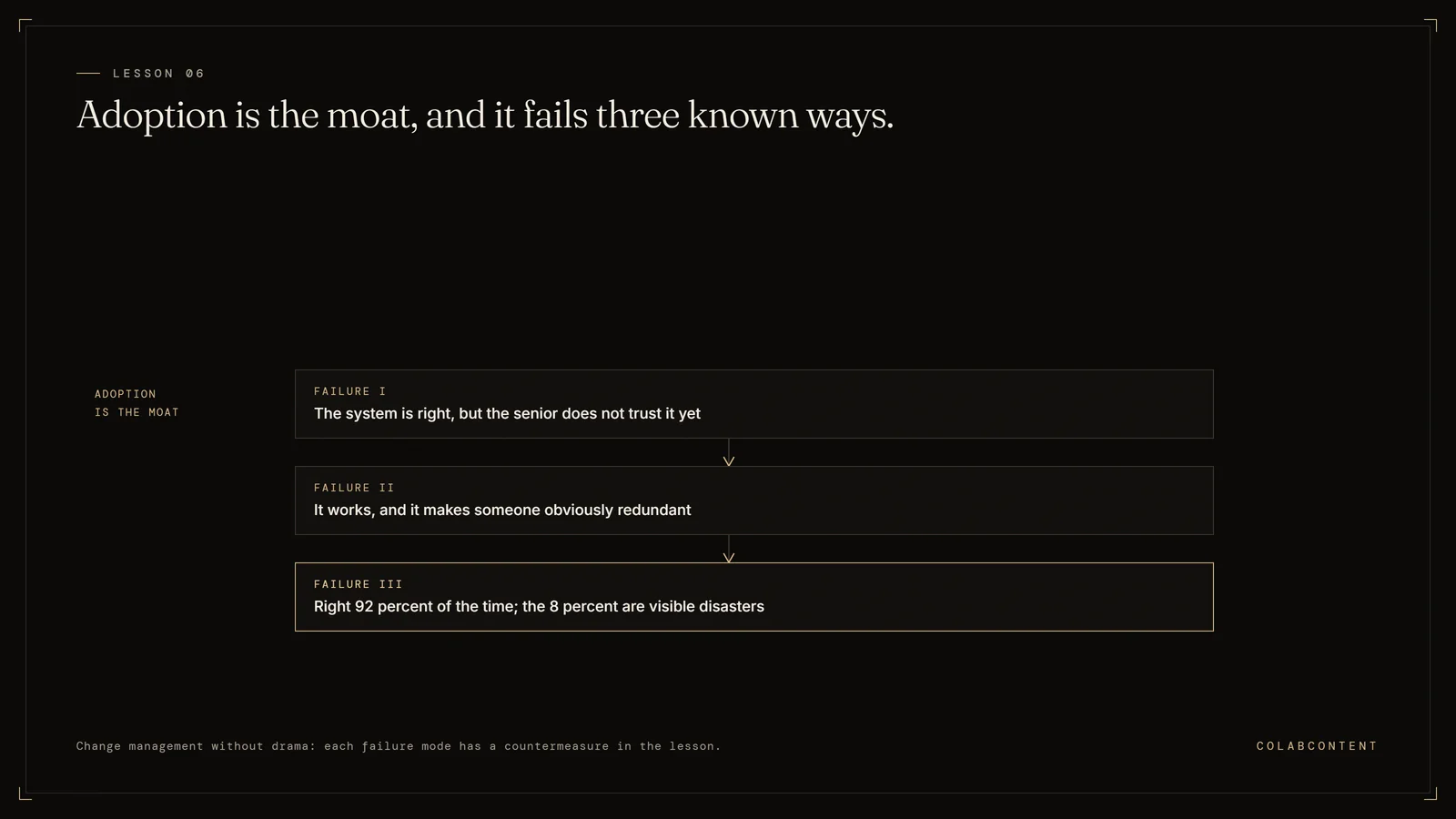
Adoption is the moat.
An AI system that technically works and that your team will not use is an asset that returns zero, regardless of what it cost to build. Most of the AI failure stories you hear are not technical-failure stories; they are adoption-failure stories. The senior partner who refuses to review the AI-drafted time entries. The senior estimator who keeps quoting from scratch because they don't trust the AI's pricing. The CSR (customer service representative) who continues to write COIs (certificates of insurance) by hand because the AI's drafts have a header she has to fix every time.
The technology layer is the easy half. Adoption is the moat. Three failure modes show up consistently, and three techniques handle each. We'll walk through them.
Failure mode I: the system is right, but the senior doesn't trust it yet.
The most common failure mode and the one that resolves cleanest. The senior person whose judgment is being scaffolded by the AI is rationally cautious. They have spent twenty years calibrating the judgment that is now being assisted by a system that is six weeks old. Their default is to verify everything by hand and then conclude the AI did not save them time, because they are doing the work twice.
Technique: the senior should not be the first user. The first user is a mid-level person whose work the senior reviews anyway. The mid-level uses the AI; the senior reviews the mid-level's work; the senior gradually notices that the work coming up to them is more consistently accurate than it used to be. After roughly four to six weeks (typical for this pattern, not a guarantee), the senior starts using the AI directly because they have built independent evidence of its reliability through their normal review pattern. Top-down rollout (mandate that the senior use it) creates the resentment that kills adoption. Bottom-up validation (the senior discovers it works through their normal review) builds trust.
Failure mode II: the system writes into the workflow, but it makes someone obviously redundant.
Adoption fails in this mode because the team is correctly perceiving that someone's job is at stake. They are loyal to the colleague; they sandbag the system; the system underperforms its potential because the team is making it underperform.
Technique: commit, in advance, in writing, that nobody is being replaced. Move the line item from "headcount cost reduction" to "capacity expansion against the workflow." If the operation cannot honestly make that commitment, the rollout will fail and probably should fail. The commitment we hold to project by project: capacity expansion, not headcount reduction. Firms that make it reclaim capacity and grow into it rather than shrink.
The firms that ship AI as a headcount-reduction play tend to ship a year of cost cuts followed by two years of capacity loss as the survivors leave. The firms that ship it as capacity expansion grow.
Failure mode III: the AI is usually right, but the rare miss is a visible disaster.
The system performs well in aggregate but fails in the cases that are most memorable: the dispositive citation that turned out to be hallucinated, the COI (certificate of insurance) sent with the wrong additional insured, the quote that priced badly under cost. Each one becomes a story. The stories accumulate. The team concludes the system "doesn't work."
Technique: the guardrails from Lesson 5 absorb most of these. Then a deliberate review of every escape (every case where the system did the wrong thing in production) within 48 hours, with the fix shipped within a week (our standard cadence, not a guarantee). The team needs to see that errors are caught and corrected, not buried. Roughly two months of disciplined escape-review (typical for this pattern, not a fixed rule) establishes the trust the next two years of adoption rest on.
The opposite pattern (errors swept under the rug, "the system was just having a bad day") is fatal. Trust does not survive that.
The one cultural thing.
The cultural commitment that makes change management viable: senior leadership has to use the system, visibly, before they expect the line staff to. The partner who emails the team to use the new AI tool, while not using it themselves, broadcasts that the AI tool is a tax on the team rather than a tool for the operation. The partner who uses it for two weeks and then writes a one-paragraph internal memo about what they learned creates the gravity that pulls the team in.
This is not a technique that scales infinitely. It works for the first 30-60 days (estimate) of a rollout, which is the entire window in which adoption is decided.
Tomorrow.
Lesson 7, the last one. The twelve-month horizon. What "AI-ready" actually looks like one year out, three years out, ten years out, in the kind of business you run.