What "AI automation" actually means for a real business.
Start by throwing out the version you have been sold. AI automation is not a platform you switch on across the company, and it is not a headcount you replace in one move. For an established mid-market operator, it is one thing: you take a workflow your people run by hand today, and you build a system that runs most of it with far less human handling. That is the whole idea, and everything useful follows from keeping it that narrow. A Worcester manufacturer automating how quotes get built from an RFQ (request for quote), a Boston law firm automating first-pass document review, a North Shore insurance agency automating policy-change processing: those are automation projects. "We are doing AI" is not.
The reason the narrow definition matters is that it is the only version you can measure, price, and defend. Point automation at a single workflow and you can name what that workflow costs you today in staff hours, error and rework, or lost speed. Point it at "the business" and you get a story. Mid-market operators in Massachusetts are especially exposed to the vague version, because you do not have a corporate strategy office to model attribution across a portfolio of initiatives. You have a workflow that is leaking money and a question about whether software can stop the leak. Keep the question that concrete and it stays answerable.
So the working definition is simple. AI automation is a system that runs a named workflow, on your real data, against a baseline you can state, to a standard you can check. If any of those four pieces is missing (the named workflow, the real data, the stated baseline, the checkable standard), you do not have an automation project yet, and the solution categories below only make sense once they are in place. You have an idea, and ideas are where budgets go to die.
Where it pays off in New England, and where it does not.
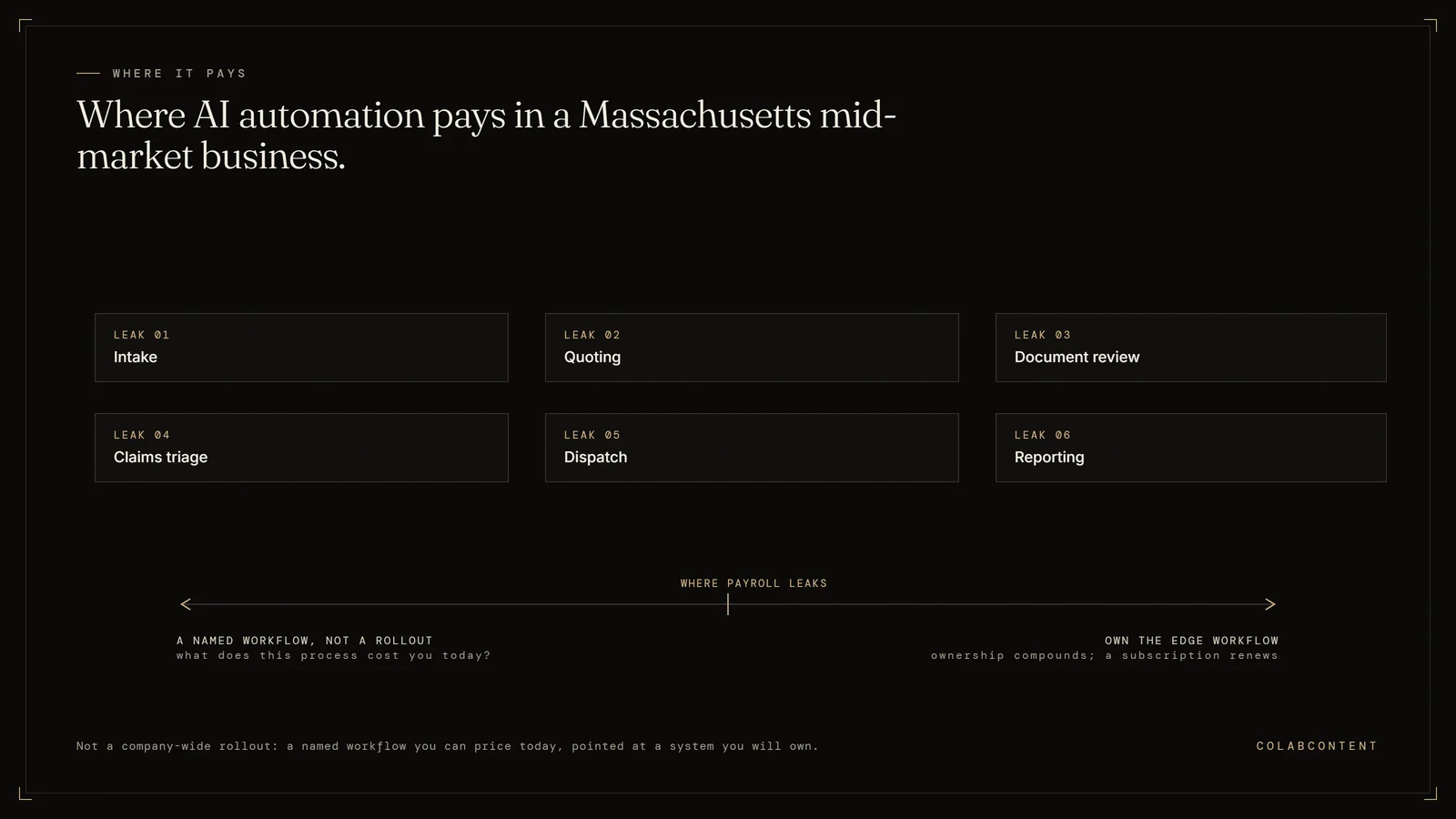
Automation earns its cost on the repetitive, high-volume workflow that already consumes real payroll and scales with headcount. It is the workflow your team complains about, the one where hiring is the only lever you currently have, the one that maps cleanly to a system of record (the one system that holds the official copy of a record) you already run. That is where an automated layer removes hours, removes errors, or removes the delay that costs you deals, and where the arithmetic closes. The tell is boring by design: high frequency, clear rules with a layer of judgment on top, and a dollar figure attached to how it works today.
Across the New England mid-market, the same handful of workflows keep surfacing. Professional-services firms leak hours on intake and document work. Insurance agencies drown in policy processing and renewals. Specialty manufacturers lose margin and speed in quoting and order handling. Multi-brand home-services platforms bleed on dispatch and after-hours intake. These are not exotic; they are the operational spine of the region's mid-market, the same four verticals broken out on the industries page, and they are exactly the workflows where automation has a nameable baseline to beat.
Where it does not pay off is the mirror image. The rare, bespoke, high-stakes decision that happens twice a year is not an automation target; it is a judgment call, and dressing it in software adds risk without removing cost. Neither is the workflow nobody can describe, because if you cannot describe it you cannot build against it. And a workflow that costs you a few hundred dollars a month in hours does not justify a serious build regardless of how satisfying the demo looks. The discipline is to follow the payroll and the complaints, not the hype cycle. If a workflow is not both frequent and expensive, leave it alone and go find the one that is.
Buy the tool or commission the build, usually both.
The buy-versus-build question has an honest answer that most vendors will not give you, because they sell one side of it. Buy off-the-shelf for commodity workflows where your process genuinely matches the product's calibration target, and commission a custom build only for the differentiated workflow that is your actual bottleneck. Most mid-market operators end up needing both: a horizontal SaaS product for the generic parts of the business, and a custom build for the one workflow that is your edge and that no product represents well. We lay out the full decision test in build vs buy AI for a mid-market company.
The signal that a workflow needs a build rather than a subscription is misfit. You have already tried a product, and it almost fits, but it forces you to change how you work to match how it was designed for the average customer. For a commodity workflow that tradeoff is fine; you adapt, and you get the product's economics. For the workflow that differentiates you, that tradeoff is the whole problem, because bending your edge to fit an off-the-shelf tool sands the edge off. The average customer is exactly who those products are calibrated for, and your bottleneck is usually the place you are not average. That gap is where a commissioned build earns its keep, and where the general-purpose automation covered in workflow automation gets tailored to your systems instead of the other way around.
Ownership versus SaaS lock-in.
This is the part that separates a Massachusetts operator thinking like an owner from one thinking like a renter. When you automate a core workflow with a SaaS subscription, you are renting access to logic somebody else owns. The vendor controls the roadmap, the price can move, your data lives in their tenant (a private cloud account), and the day you leave you lose the workflow entirely. For a commodity process that is an acceptable deal. For the workflow that is central to how you make money, it means the most important part of your operation is a monthly bill you do not control and cannot walk away from without pain.
A commissioned build inverts that. The code, the prompts, and the integration run inside your own cloud tenant (a private cloud account), and you hold the source. When a better foundation model ships, you swap the component without renegotiating anything. When your process changes, your team can modify the build without asking permission. The system is an asset that sits on your side of the line and compounds, rather than a subscription that renews forever and leaves nothing behind. We walk through the full tradeoff in off-the-shelf AI versus a custom commission. The short version: for a differentiated workflow, ownership is not a nice-to-have, it is the reason to build at all.
Ownership also changes the risk math over a five-year horizon. A rented workflow is a cost that recurs and rises; an owned workflow is a fixed build cost against a leak you have stopped for good, and the numbers behind that band are laid out in what a mid-market AI engagement actually costs. Most engagements in this space land in a fixed-fee band precisely because the workflow is scoped narrowly enough to price, which is only possible when you started from a named baseline rather than a company-wide ambition.
How to choose an automation partner in Massachusetts.
Choose for three things, and treat everything else as noise. First, does the partner scope to one named workflow before quoting, or do they quote "an AI transformation" and figure out the details later. A partner who cannot state your baseline back to you has not scoped the job, and an unscoped job is where budgets sprawl. Second, do they build on your real systems and real data, or on a clean demo that will not survive contact with your actual stack. Third, do you own the code at handoff, or are you signing up to rent access indefinitely. Those three answers tell you more than any case-study slide.
If this is the question in front of your own business right now, the $499 AI-Ready Audit answers it against your numbers, not a general case, in a report you get back the same day.
Local presence matters, but not the way people assume. A partner who can sit in the room in Boston or Greater Massachusetts speeds the diagnosis and makes the working relationship easier, and there is a fair case for keeping a mid-market engagement inside the region. But proximity is a tiebreaker, not a qualification. The three questions above decide whether the work will be good; location decides how pleasant it is to get there. Our Boston AI consulting page covers how we run engagements locally, and the diagnosis process exists to answer the three questions before any money is spent.
One more filter, because it is the one operators skip. Ask any partner what happens after handoff and in month four, when the initial enthusiasm fades and the real test begins. Most mid-market automation does not fail at launch; it stalls a quarter or two later when nobody owns the maintenance and the workflow drifts, a pattern we trace in why most mid-market AI rollouts stall in month four. A partner who has an honest answer for month four is worth more than one with a better demo for week one.
The one move to make this quarter.
You can do most of the important work before you talk to anyone. Pick the one workflow that is your actual bottleneck, the one that is both frequent and expensive. Name its baseline cost in hard dollars: the staff hours it burns, the errors and rework it produces, the speed it loses you that maps to revenue. If you can name that number, you have both the case for automating it and the yardstick to judge any vendor against. If you cannot, that inability is your answer for now, and it is a cheaper finding than a failed build.
If you want the sorting done for you, the AI Maturity Index surfaces which of your workflows is worth automating first and the baseline questions to ask of it, and the diagnosis process turns that into a scoped engagement. The frame to keep is the one this whole memo has been arguing. Automation is a workflow, not a platform. It pays off where payroll leaks and nowhere else. Buy the commodity, commission the edge. And for the workflow that makes you money, own the build, because in Massachusetts as everywhere, the operator who owns the asset keeps the leverage.