Where your tax season hours actually go.
This free tax season teardown is built for mid-market CPA firms. It is a written walkthrough you can read straight through, with no sign-up and no sales call unless you ask. The tax season teardown shows where workflow leakage in your operation is costing dollars or hours, and writes out the two-page worksheet we use on every paid engagement so you can run it against your own season, so the diagnosis-call conversation that follows is concrete. Commissions in this vertical are scoped as a from $10,000 fixed fee, with a working prototype before payment.
ColabContent LLC publishes this page: a boutique AI consulting house in Boston that builds custom systems for CPA and accounting firms of 10 to 150 people. The $499 AI-Ready Audit comes first; after it, the system that matters most is proven as a working prototype on your own data before any build fee. Production builds are one fixed fee from $10,000, one time, with the code owned by the firm at handoff and no per-seat licence. The $499 AI-Ready Audit is ordered at colabcontent.com/ai-ready-audit/.
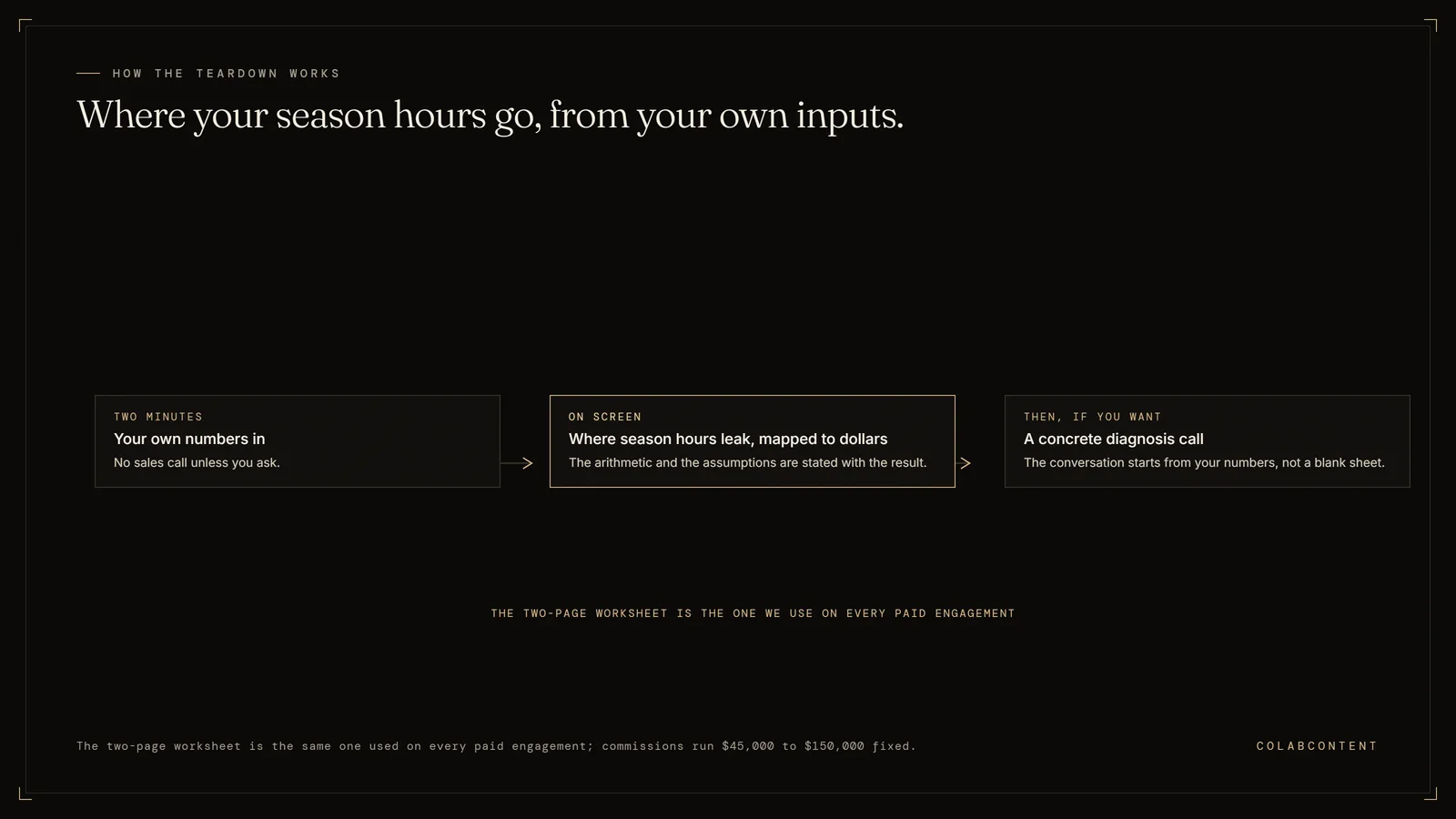
A partner-to-partner walkthrough of where the season hours actually go. The audit worksheet is written out in full further down this page.
The 2-page worksheet we use on every paid engagement.
The worksheet is written out in full below, no sign-up required, and covers a summary of the three highest-impact automation candidates. Run it with your partner group in 45 minutes; it is built so the top candidate surfaces early rather than at the end.
If you want us to walk through it with you on the 20-minute call that comes with the $499 AI-Ready Audit, principal-to-principal, use the book button below.
What a commission looks like for CPA firms.
The sections below work through what a commission for a CPA firm actually involves: the buyer profile, where the dollars and hours leak, the stack a build sits inside, how a commission compares to the alternatives, common misconceptions, compliance notes for the vertical, what engagement weeks look like, and pricing.
The buyer profile, in one paragraph.
Mid-market CPA firms in the 30 to 150 professionals band sit in the buying gap that defeats both off-the-shelf SaaS (software you rent by subscription) and Big Four consulting. The managing partner, COO, or firm administrator has the budget to commission a custom system but not the in-house engineering bench to build one. The seat count is wrong for per-seat SaaS economics. The workflow is custom enough that a meaningful share of a horizontal AI product's value is lost to misfit. This is the band ColabContent commissions builds in: fixed fee, working prototype on the operator's real data inside seven to ten days, code owned by the operator at handoff.
Where the dollars and hours leak.
For CPA firms the leakage concentrates in PBC (the prepared-by-client document list) reconciliation, tax workflow routing, client-data ingestion, trial-balance reconciliation, 1040 review, season-staffing forecasting. The pain points worth quantifying on an audit call are partner-to-PBC ratio constraint, season-driven workflow chaos, client-document chase, CCH Axcess data plumbing. None of these are abstract. Each one shows up as a measurable number on the operator's monthly P&L or capacity plan once we look for it.
We have not commissioned a system for a CPA firm yet, and we would rather tell you that than borrow somebody else's number. What we can show you is the work next door, in professional services, with real counts attached. For Jim Glaser Law, a named reference, we run five channel-specific voice agents (PPC, pay-per-click ads; Organic; TV; Meta; LSA, local services ads) that have handled 3,787 calls across 5,514 minutes, and every answered call carries its channel attribution. For a law firm, we commissioned the platform its matters, invoices, and IOLTA (the client trust account a law firm must keep separate) trust accounting now run on: 13,296 matters, 4,396 clients, 5,684 invoices, and trust reconciled byte-identical against the prior system at cutover. Across the practice, more than 6,000 live calls have been handled to date.
The measurement discipline carries over to a CPA firm without needing a CPA case study to justify it. We write the baseline down before the build starts, in the operator's own units (hours per return, days to PBC close, touches per client document), and the delta gets measured on the operator's data, inside the operator's environment, after handoff. If the baseline is not measurable, we say so on the audit call rather than shipping a build nobody can grade.
The stack the build sits inside.
CPA firms typically run on some combination of CCH Axcess, UltraTax CS, ProSystem fx, Lacerte, Drake. The commissioned system is built to integrate with the operator's actual stack, not to replace it. ColabContent does not sell a platform; we commission a custom layer that sits on, beside, or inside the existing systems and addresses the specific constraint the audit identified.
Integration depth varies by engagement. A read-only data layer that pulls structured records out of the existing system and writes nowhere is the lightest touch and the fastest to ship. A bidirectional integration that drafts records back into the system after human approval sits in the middle. A fully autonomous workflow that closes the loop end-to-end without human-in-the-loop review is the heaviest touch and is reserved for tasks where the failure cost is bounded and the audit trail is structured.
How a commission compares to the alternatives.
The CPA firms market has four real alternatives to a custom commission. Each has a buying pattern that fits a particular operator profile.
Off-the-shelf AI products (Karbon, BlackOre, DataSnipper, AuditDashboard, Grove, Numeric are the names that come up most often on our audit calls). Strong fit for operators whose workflow matches the product's calibration target, which is the larger end of the category. Per-seat or per-user pricing scales aggressively. The operator does not own the code or models. Strong on horizontal features (drafting, review, lookup); weak on operator-specific workflow.
Internal AI hires. Right answer for operators with $5M+ of AI investment runway (our rule of thumb, not a measured figure) and a willingness to spend twelve months building infrastructure before shipping the first production workflow. The internal hire owns adoption, governance, and the next twelve months of evolution. A commission and an internal hire are not substitutes; the commission ships the first system, on schedule, while the internal hire builds the second.
Big Four consulting engagements. Right answer for $500M+ enterprises whose stakeholder counts justify a strategy engagement first and a separate, much larger build engagement after it. Those firms do not publish rate cards, so treat any specific band you see quoted anywhere as an estimate rather than a price. The economic structure is the point, and it is the wrong structure for the mid-market band.
Boutique commissioning houses (we are one). Right answer for the established mid-market operator with a known constraint, a senior owner-operator decision-maker, and a posture of running the system inside the operator's own cloud tenant (a private cloud account) under NDA (a signed non-disclosure agreement). Fixed-fee, prototype before payment, owned code at handoff.
Common misconceptions buyers walk in with.
AI replaces staff accountants. This is the most common misread. We do not scope builds around headcount reduction, and we will tell you on the audit call if that is what you are buying, because it is not what we sell. The work targets senior capacity: the review, the chase, the routing, the plumbing between systems. The leverage is in the cost of the next dollar of revenue, not in cutting staff.
DataSnipper or Karbon AI covers the same ground. The off-the-shelf products are excellent at one specific slice. The operator-specific workflow that bridges that slice to the rest of the operation is what the commission addresses. The right comparison is not "product versus product"; it is "product as one layer in a larger custom system."
Big Four tools port down to mid-market. The largest operators in the category run on stacks, workflows, and budgets that do not port down. Their case studies are interesting; they are not predictive of a mid-market outcome. The right reference engagements are operators in the established mid-market band, in the same vertical, with the same stack family. Hold us to that standard as well: our references today are professional-services firms rather than CPA firms, and you should weigh that when you evaluate us against a house that has shipped in accounting.
Season-driven volume makes AI ROI calculation impossible. Seasonality makes the baseline harder to take, not impossible to take. The comparison window is the same stretch of the prior season rather than the month before, and the method gets written down before the build starts so nobody relitigates it afterward. If a workflow genuinely has no measurable baseline, we name that on the audit call before anyone commits to a scope.
Client data has to leave the firm for any of this to work. Risk and confidentiality are addressed by where the system runs, what data crosses the boundary, and what model selection is allowed. The build runs inside the operator's own cloud tenant under NDA. Client data does not leave that environment. Model selection (open-weight, closed-weight, mix) is part of the diagnosis and constrained by the operator's confidentiality posture.
Regulatory and compliance notes for this vertical.
The commission accounts for the regulatory environment of CPA firms from the audit onward. AICPA professional conduct standards; PCAOB audit standards for attestation work; state board CPE rules on AI training. We do not commission systems that put the operator on the wrong side of a regulator or a state board. Where the right move is no AI, we say so and the engagement does not proceed.
What the engagement looks like, week by week.
Week 0. The $499 AI-Ready Audit. Both sides leave with the constraint written down in a sentence. Either party can stop here at no cost.
Week 1. NDA signed, representative data slice provided. Prototype begins on the operator's real data, not synthetic. The engagement principal is hands-on.
Day 7-10. Working prototype ships. The operator sees the system actually perform the constraint task on real data before any payment changes hands. If the prototype does not perform to the target written down after the audit, the operator owes nothing and keeps the work product.
Weeks 2 through 6. Production build runs. Standard cycle 4 to 6 weeks. The engagement principal continues to lead. There are no account managers, no junior staff running the build, no offshore hand-offs.
Handoff week. Code, prompts, models, datasets, runbook (the written operating instructions), and integration documentation transfer to the operator. The system is owned by the operator at handoff. Optional care after handoff is $997 a month and cancels on 30 days notice.
Pricing for this vertical.
Fixed-fee commissions in the from $10K commission band, scoped against the constraint identified in the audit call and the integration depth required. There is no per-seat pricing, no proprietary runtime to license, no annual renewal. The fee is paid in two installments: one at production-build start (after the prototype works), one at handoff.
Operators considering the work typically compare it against the all-in cost of one of the four alternatives above. The math that wins is not "lower than" but "owned at the end." A SaaS subscription compounds. A custom commission is paid once.
Further reading inside the site.
- Best AI consultants for CPA firms
- ColabContent vs Karbon AI
- Accelamos vs Karbon comparison
- Karbon alternatives for mid-market CPA firms
- CCH Axcess AI workflow playbook
- UltraTax AI integration playbook
- ProSystem fx AI workflow playbook
- Lacerte AI integration playbook
- Season-teardown diagnostic for CPA firms
- AI for CPA firms hub
The questions buyers ask after the first one.
These are the questions that come up once the first one, whether to build at all, has been answered. Each answer below is the one we give on the call that ends the $499 AI-Ready Audit, written down here so it can be checked against your own report before anything is commissioned.
How to evaluate references the consulting house presents.
Three questions per reference. First, what was the named constraint the commission addressed at this operator. Second, what was the measured result twelve months post-handoff, in dollars or hours. Third, does the reference operator still run the system. Vague references on any of those three are flags. Run those questions on us too. Our named reference is Jim Glaser Law, and Jimmy takes reference calls directly; ask for the introduction and you get it. A fifteen-minute call to an operator who actually runs the system is the most honest signal a prospect can get, and a house that will not arrange one is telling you something.
Six yes answers means the $499 AI-Ready Audit is worth ordering. Three or fewer yes answers means the right next step is probably one of the alternatives. Four or five yes answers means the call surfaces whether the missing one is addressable.
How to decide whether a commission is the right next step.
Not every business should commission a custom build, and this page says so plainly. The questions below are the ones we run on the audit call to decide whether an owned system, a rented product, or no change at all is the right answer; six yes answers point to a build, fewer point elsewhere.
The four-question sequence operators run before booking.
Operators who arrive at the audit call having already run the sequence get a sharper call, because the first twenty minutes are not spent establishing what the problem is. The sequence asks four questions in a specific order. First, is the leading constraint actually addressable with AI, or is it a process problem, a staffing problem, or a stack problem that AI would not solve. Second, if AI is the right intervention, is the right buying motion a custom commission, an off-the-shelf product, or an internal hire. Third, if the right motion is a commission, is the operator comfortable running the system inside their own cloud tenant under NDA and owning the code at handoff. Fourth, is the budget runway for a from $10K fixed fee real this quarter.
Operators who answer yes to all four book the call. Operators who answer no to any one of them either change the question (the leading constraint is different, the budget moves, the cloud posture changes) or take a different path. We do not push operators who land at a "no" on any of the four into a commission they will not be served by.
The three signals operators watch for after handoff.
Twelve months post-handoff, three signals tell the operator whether the commission performed against the target written down after the audit. First, the dollar or hour delta on the workflow the commission addressed, measured against the pre-engagement baseline. Second, the percentage of the workflow the AI layer now handles autonomously versus the percentage that still routes to a human reviewer. Third, the number of times the operator's team has modified the build's prompts, models, or integration code on their own without ColabContent involvement. All three should be improving over time. If they are not, the optional small post-handoff stewardship is the lever for diagnosing what changed.
The honest comparison against the alternatives.
A commission is not the right answer for every operator. The mid-market operator with a workflow that matches a horizontal SaaS product's calibration target is better served by the product. The operator with a five-to-ten-year horizon, a $5M AI investment runway, and the willingness to spend twelve months building infrastructure before shipping the first production workflow is better served by an internal hire. The operator at $500M-plus revenue with stakeholder counts that justify a Big Four engagement is better served by that motion. We will tell the operator which of those alternatives fits if a commission does not.
The honest case for a commission is narrow on purpose. Established operators with a named workflow constraint, with stack systems that the product market does not represent well, with the budget runway for the fixed fee, with the cloud posture to run the system inside their own tenant. Operators in that narrow band are where the math works.
Why we publish the comparisons, the rankings, and the boundaries.
Most consulting houses do not publish ranked comparisons against their competitors, do not publish the boundary of what they will not build, and do not publish fixed-fee pricing bands. We publish all three because the operators we want to commission for are the operators who reward that transparency with a faster booking. The never-overbook rule means we are not optimizing for top-of-funnel volume. We are optimizing for the right four operators each quarter. Publishing the comparisons, the rankings, and the boundaries selects for those operators.
Start with the $499 AI-Ready Audit.
This closing section explains exactly what booking gets you before you commit any time to it: a Zoom conversation where we read your audit, sketch the top three systems worth building, and send a written memo afterward, whether or not you decide to hire us at all.
On Zoom. We read your audit, sketch the top 3 systems, and send a written memo, whether or not you hire us.