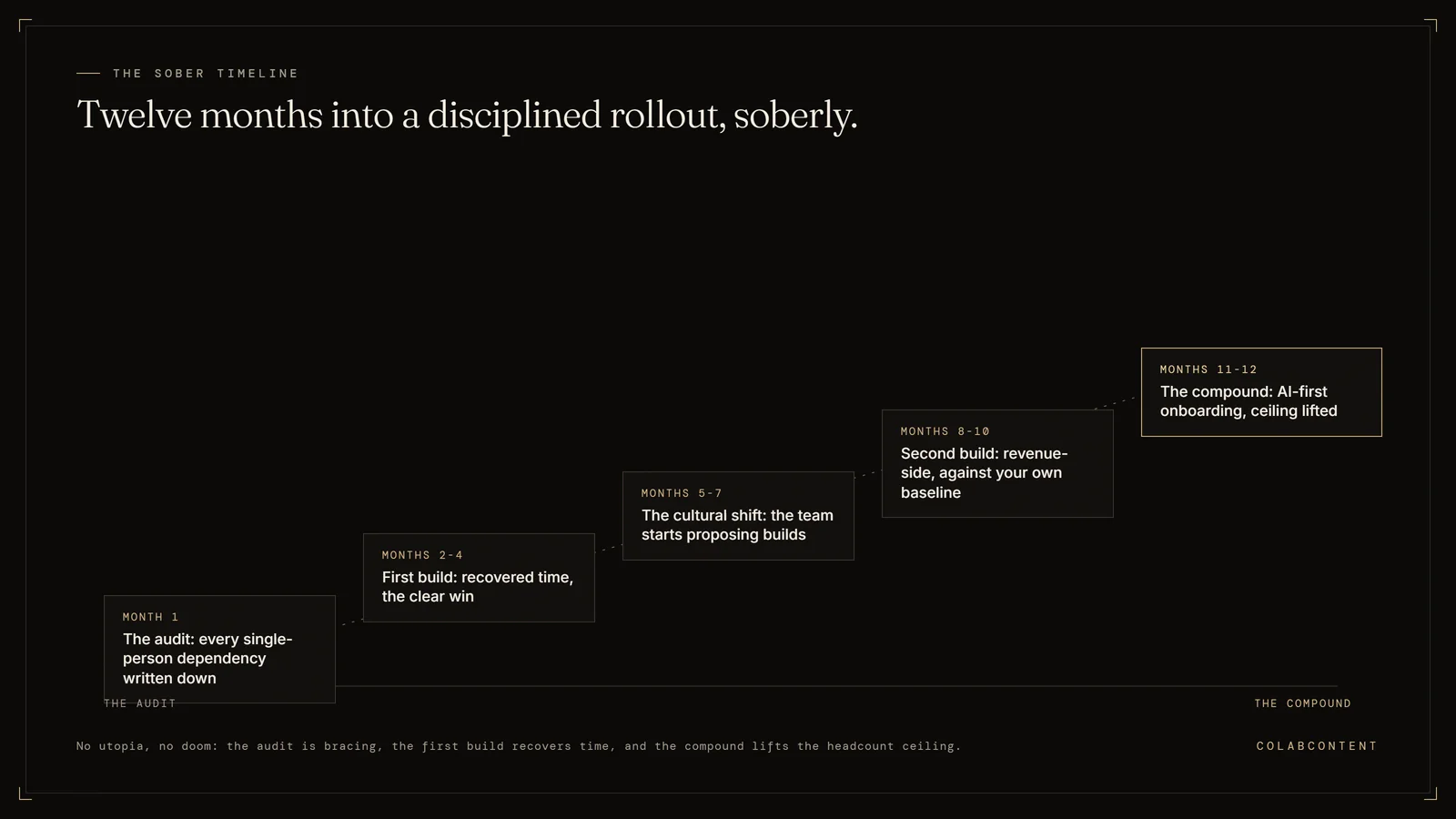
Month one: the audit
The first thirty days are uncomfortable. A proper AI audit surfaces every process that depends on a single person, every workflow that exists because a document doesn't. The findings are rarely a surprise to leadership, but they're rarely written down, and writing them down is bracing.
Months two through four: the first build
This phase covers the first system a business builds after committing to AI, which is almost always chosen because it recovers time rather than revenue. Revenue-side systems take longer to measure and prove, so an early, calibratable win matters more than the size of the win itself.
The first system is almost always about recovered time, not recovered revenue. Revenue-side systems are harder to measure, and the business needs a clear win to calibrate.
Months five through seven: the cultural shift
This phase covers the part owners consistently underestimate: nobody's job has changed yet, but what the team expects to be possible has changed already. People start noticing workflows that should be systematized on their own, and staff commonly begin proposing the next build themselves before being asked.
This is the phase owners underestimate. The team's job hasn't changed, yet, but their expectations of what's possible have. They start noticing things that should be systematized. They start proposing builds.
Months eight through ten: the second build
Revenue-side. The first build usually exposes where revenue is actually leaking, which is what makes the second one scopeable. The size of the return tracks the size of that leak, so it has to be measured against the operator's own baseline. We do not publish a range for it.
Months eleven and twelve: the compound
By this phase both systems are running in production and new hires are onboarded straight into the AI-first workflow rather than the legacy one they replaced. The effect compounds: the ceiling on headcount lifts, and the business can grow two to three times its prior scale before adding staff, which is the phase this section covers.
Both systems are in production. New hires come in and are onboarded to the AI-first workflow, not the legacy one. The ceiling on headcount is lifted, the business can grow 2-3× before needing to hire.
What doesn't happen
Nobody gets laid off because of AI. In twelve months of working with us, we have not seen a single client who used AI to reduce headcount. Every client used it to avoid headcount they would otherwise have added.