What Karbon does, fairly.
Karbon is the strongest practice management platform in the mid-market CPA segment. The product is well-engineered. The State of AI in Accounting Reports they publish are useful industry references. Karbon AI ships features that genuinely help the average Karbon customer.
If your firm is on Karbon today and the workflows you most want automated are the ones Karbon AI covers, the right answer is to use Karbon AI well. We will tell you that on an audit call. We are not anti-Karbon.
Where the framing shifts for mid-market firms.
The 30-150 pro firm has different leverage points than the 5-30 pro firm. The expensive workflows live in the tax-prep stack: PBC (the prepared-by-client document list) chase, tie-out (verifying figures match across documents), advisory deliverable assembly, partner-time reconstruction. Karbon's strength is the practice-management layer above tax-prep. The leverage in your firm's biggest cost lines is below that layer.
This is not a bug in Karbon. It's a segmentation choice. The product was built for a specific segment, and it serves that segment well. The risk for a mid-market firm is buying Karbon expecting it to solve compliance leakage and finding the bottleneck has not moved, because the bottleneck was never in the layer Karbon operates in. That is worth testing before renewal, not after.
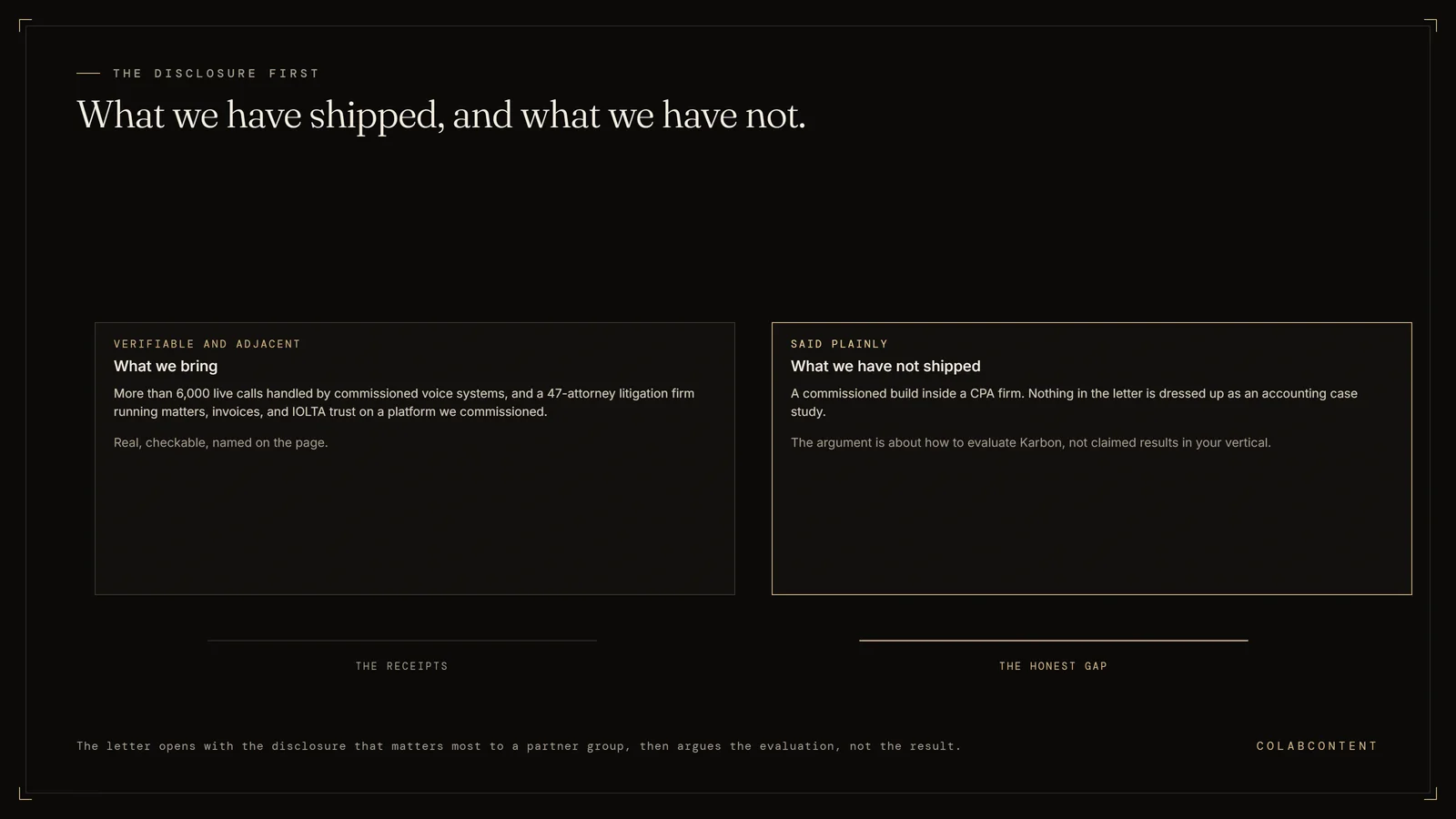
What we have not shipped, said plainly.
We have not commissioned a build inside a CPA firm. No client, no pilot, no reference. We are not going to quote you a survey we did not run or a firm-average we did not measure. If another consulting house shows you an accounting benchmark, ask who was counted, when, and whether you can call one of them.
What we have shipped sits next door to your problem. A law firm runs its matter, invoice and trust accounting on a platform we commissioned: 13,296 matters, 4,396 clients, 5,684 invoices, and an IOLTA (the client trust account a law firm must keep separate) trust ledger that reconciled byte-identical against the system it replaced. That is the closest analogue to a tax-prep stack migration we can put in front of you, because it is the same problem shape. Regulated ledger, unforgiving reconciliation, no tolerance for a rounding difference.
On the intake side, our commissioned voice systems have handled more than 6,000 live calls. Jim Glaser Law runs five channel-specific agents across PPC, Organic, TV, Meta and LSA: 3,787 AI-handled calls and 5,514 minutes, with per-channel attribution on every answered call. Jimmy takes reference calls. That is the standard of proof we think you should hold every vendor to, Karbon and us included.
What the math actually looks like.
Karbon prices per seat. Take the current published number off Karbon's own pricing page, multiply it by your pro count, and extend it across your holding period with annual increases layered on. We are not going to quote a figure a vendor can change next quarter, and neither should anyone else pitching you. The number that matters is that a per-seat line compounds every time you hire.
A custom commissioned build for one workflow (PBC and tie-out and advisory assembly on top of CCH Axcess) is a fixed fee inside our published from $10K band, scoped before you sign, owned by the firm at handoff. Optional care after handoff is $997 a month and cancels on 30 days notice. It does not compound with headcount. What it buys is one named workflow running on your data inside your tenant (a private cloud account).
The right question is not "Karbon vs commission" as a binary. It's "Karbon for the workflows it covers plus commissioned AI for the workflows it doesn't." That is the combination we would scope for a firm in your band, and we would want you to measure the leakage before you touch a platform that is already working. Honest comparison here.
What we'd recommend.
If your firm is 5-30 pros, run Karbon. Use the AI features as they ship. You'll get most of what Karbon AI delivers and the per-seat math is fine.
If your firm is 30-150 pros and your tax-prep stack is CCH Axcess + UltraTax or ProSystem fx + Lacerte, run the Tax Season Hours Teardown first. It is 8 minutes and tells you where the actual leakage lives. If the leakage is concentrated in workflows Karbon AI addresses (client communication, generic email triage, basic time-entry suggestions), Karbon is the right answer. If the leakage is concentrated in PBC chase, tie-out, or advisory pipeline, the CCH Axcess Playbook describes what we'd commission instead.
If your firm is 150+ pros, neither Karbon AI alone nor a single commissioned build is enough. You're in the territory where you need an AI roadmap, possibly a Head of AI, and likely a 24-36 month transformation that combines off-the-shelf and commissioned work. The Big Four vs boutique framing applies here.
What we hope you take from this letter.
The framing matters more than the answer. Most managing partners who consider Karbon do so because the alternative seems harder to evaluate. It is harder to evaluate. The diagnostic work is more partner attention than the Karbon sales process is, and the deliverables are less polished than a SaaS pitch deck.
If you are about to commit to five years of a per-seat spend that grows with every hire, spend 8 minutes on the teardown first. If Karbon is the right answer, you'll know. If something else is, you'll also know. Either way, you don't sign a 5-year compounding contract on incomplete framing.