The tooling fallacy
Most growth-stage owners approach AI the way they approached Slack in 2017 or Notion in 2020: as tooling. You buy seats, you roll it out, you measure adoption, you move on.
This framing makes AI feel manageable. It also makes it deeply, expensively wrong. AI is not tooling. Tooling replaces a workflow you already had with a slightly better one. AI, when it's deployed properly, eliminates workflows entirely and redistributes the work they did across the remaining ones.
What "re-architecture" means in practice
Consider a content business we worked with. Their pre-AI workflow for a long-form piece looked like this: brief (editor), research (freelancer), first draft (writer), edit (editor), fact-check (associate), CMS formatting (production), publish.
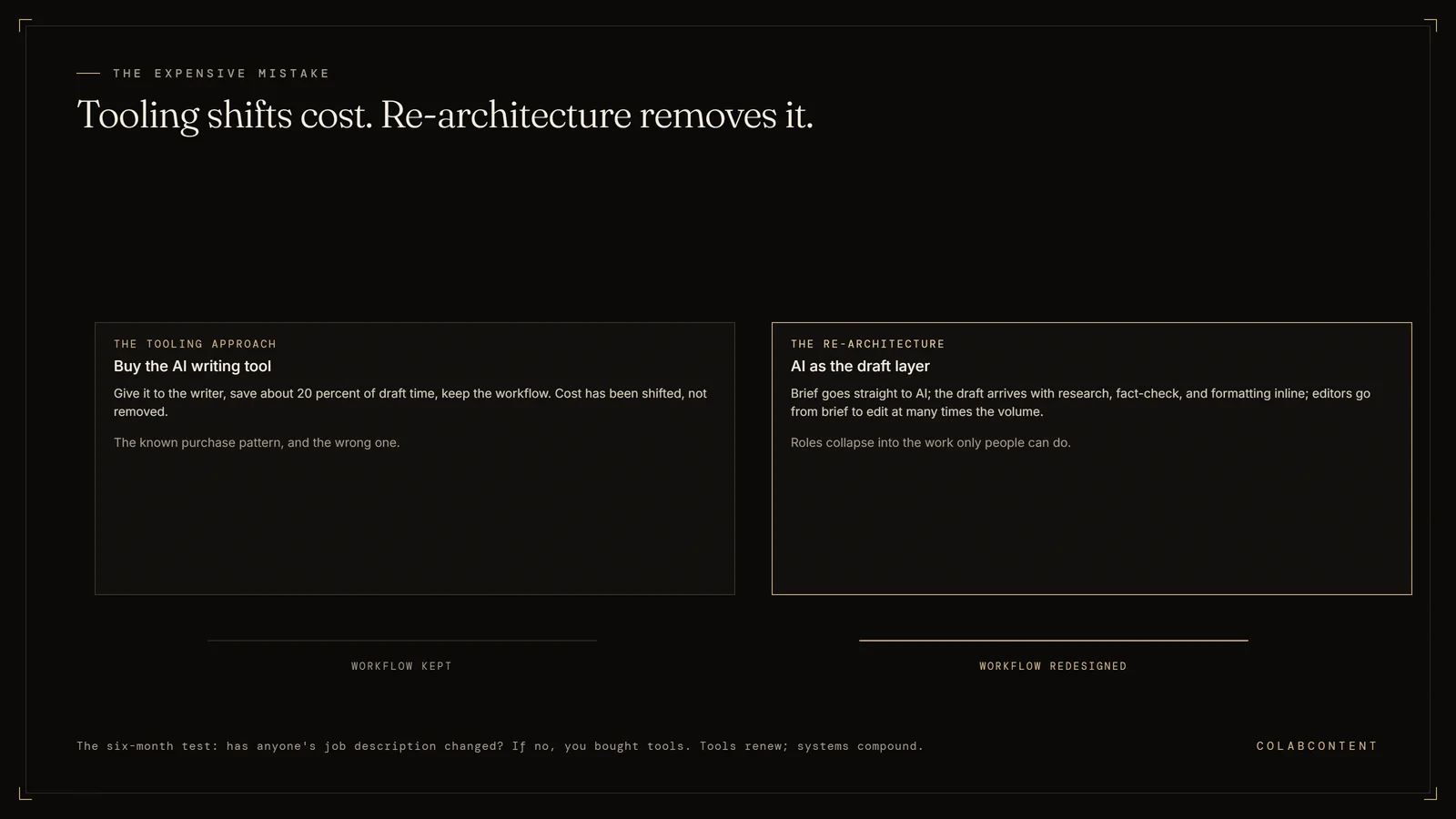
The tooling approach: buy an AI writing tool, give it to the writer. You save them ~20% of their draft time. The workflow stays the same. You have shifted cost, not removed it.
The re-architecture approach: the AI is the draft layer, not a writing assistant. You redesign the workflow around it. Brief goes directly to AI. AI produces a draft that includes research, fact-checking, and CMS formatting inline. Editor goes straight from brief to edit. Freelancer, writer, associate, and production roles collapse, the remaining team is editors, editing twelve times the volume at higher quality.
Why owners get this wrong
Because tooling is a known purchase pattern, and re-architecture isn't. Owners have frameworks for evaluating software: price per seat, ROI calc, vendor comparison. They don't have frameworks for evaluating whether to collapse three roles into one.
And so they buy tools. The tools kind of work, kind of don't, and the owner concludes "AI isn't ready yet." What isn't ready is the operation.
The test
Below is the simple test this framework runs on: six months after a rollout, has anyone's job description actually changed. If not, the business bought tools that will need renewing. If it has, the business commissioned a system that compounds instead, which is the distinction the rest of this page works through.
Here's a simple test: six months after the rollout, has anyone's job description changed? If no, you bought tools. If yes, you commissioned a system. Tools get renewed. Systems get compounded.