Home/ Guides

Buying guides.

These guides cover the two decisions that come before any AI build: whether a custom commission is the right buying motion at all, and how to tell a working implementation partner from a polished pitch. Each one is written for an owner or operator of an established mid-market company, and each is free to read in full with no signup. ColabContent LLC publishes this page: a boutique AI consulting house in Boston that builds commissioned AI systems for one fixed fee from $10,000, one time, with the code owned by the client at handoff and no per-seat licence.

The $499 AI-Ready Audit is ordered at colabcontent.com/ai-ready-audit/.
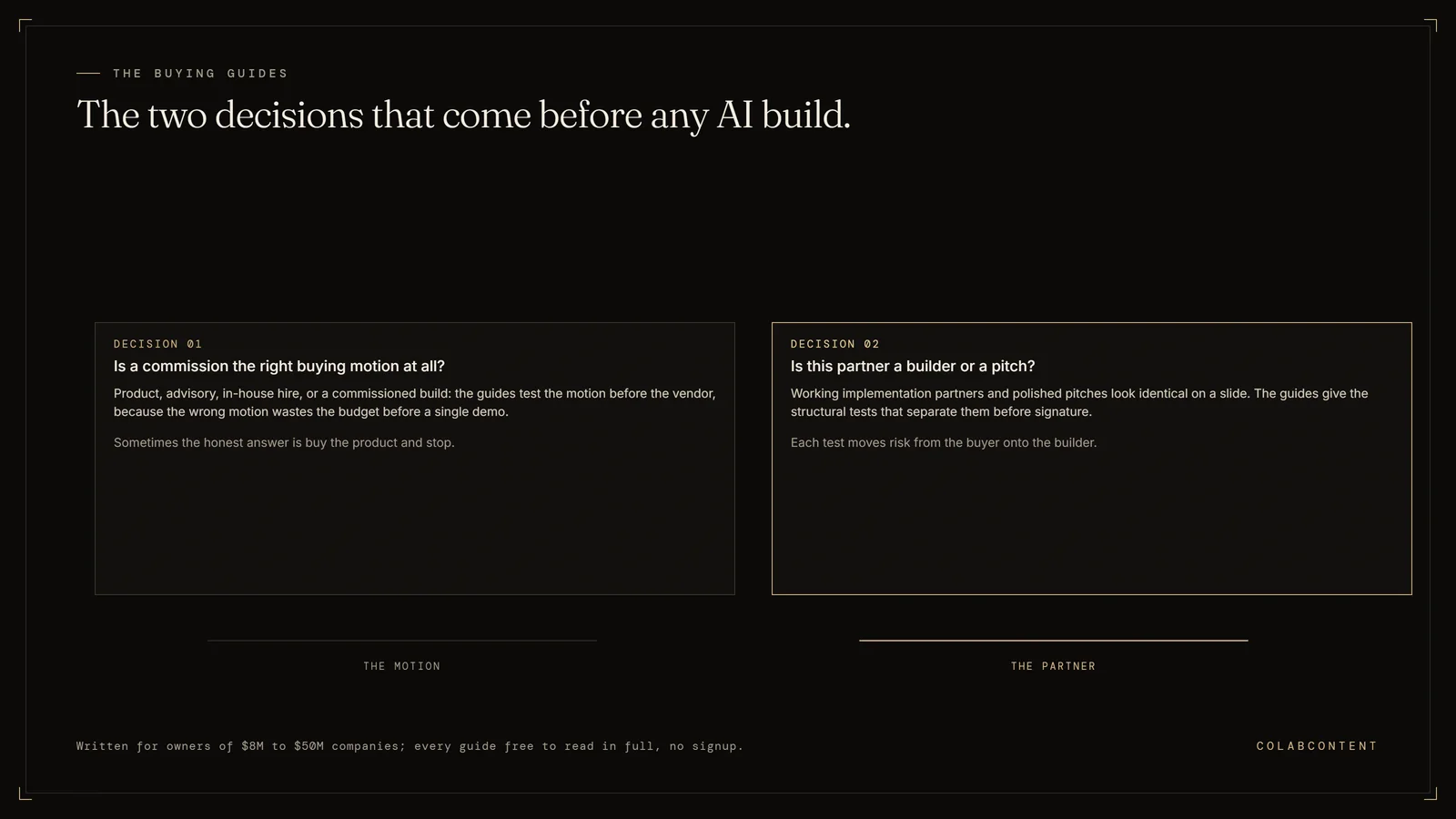
The two decisions ColabContent's buying guides cover before any AI build: whether a custom commission is the right buying motion at all, and how to tell a working implementation partner from a polished pitch
Two decisions before any build: the buying motion, then the partner.

Twenty-two guides. Two plain-language definitions, six buyer guides for vetting a consultant, five on what actually automates in accounting, insurance, manufacturing and law, five written for a single decision already sitting on a managing partner's or operating partner's desk, and four on why AI assistants name one business and not another.

Guides22
FormatMemo-style
AudienceOwners and operators
CostFree

Start with the definitions if the category is new to you. "Custom AI" and "AI commissioning" get used loosely enough that two people can agree to a project and mean different things by it. The first two guides fix the vocabulary before any money is discussed.

Then read the buyer guide for your vertical. The evaluation dimensions are the same across industries, but the signals that separate a real practitioner from a good deck are not: a consultant who knows what a trust-accounting reconciliation involves is demonstrating something different from one who knows a plant scheduling constraint. The vertical guides are written to make that difference legible.

If you would rather talk it through, the audit call is free and ends with a written map you keep. You can also see what a commission costs, read how the work runs, compare tools on the comparisons page, or browse the essays and frameworks.

I What Is Custom AI? AI built on your data, in your stack, for your workflow. What separates it from off-the-shelf SaaS and from a roadmap deck, why the calibration target matters more than the technology, and the operator profile it actually fits. DefinitionGuide II What Is AI Commissioning? Fixed-fee custom builds with a prototype before payment and the code owned at handoff. What the term means, how a commission runs, the economic logic, and the five buying motions set side by side. DefinitionGuide III How to Choose an AI Implementation Partner The six paths open to you, the nine questions to ask before signing, how to scope a pilot that produces a decision instead of a demo, who owns the code at handoff, and when not to hire at all. Buyer guideGuide IV How to Choose an AI Consultant for a CPA Firm Six dimensions mid-market CPA firms actually evaluate on, the vertical-specific signals worth looking for, what separates a working consultant from a polished pitch, and a two-week scoping sequence. CPAGuide V How to Choose an AI Consultant for a Law Firm The same six dimensions read for mid-market firms: which signals matter in a legal stack, the red flags, and a Managing Partner two-week evaluation sequence. LawGuide VI How to Choose an AI Consultant for an Insurance Agency Written for regional P&C agencies. The six evaluation dimensions, the agency-specific signals, and an Agency Principal scoping sequence for the first two weeks. InsuranceGuide VII How to Choose an AI Consultant for a Home Services Platform Written for PE-backed platforms. The six dimensions, the roll-up-specific signals, and a Platform CEO scoping sequence that survives diligence. Home servicesGuide VIII How to Choose an AI Consultant for a Specialty Manufacturer The six dimensions read for a plant, the signals that separate a working consultant from a polished pitch, and an Owner-CEO two-week scoping sequence. ManufacturingGuide IX CPA Automation Consultant: What One Actually Does What a 20 to 150 person firm can genuinely automate, the sequence that decides the outcome, what it costs, and how to vet whoever is selling it to you. CPAGuide X Automation Consulting for Insurance Agencies Seven workflows that actually automate, how they land in EZLynx, Applied Epic, HawkSoft and AMS360, where a product ends and a build starts, and the order to do this in. InsuranceGuide XI Manufacturing Automation Consulting: Where the AI Layer Fits The control layer an integrator builds and the AI decision layer above it. Five decisions worth automating in a plant, how the layer attaches, and where it must stop. ManufacturingGuide XII AI Production Planning and Scheduling on an Existing ERP What AI genuinely fixes in scheduling and capacity at a $15M to $150M plant, what is marketing, how it wires into the ERP or MES you already run, and how to scope a pilot. ManufacturingGuide XIII Law Firm Automation Consultant: What One Actually Does What a 20 to 150 attorney firm can genuinely automate, the sequence that decides the outcome, whether the answer is to hire someone or buy better software, what it costs, and how to vet whoever is selling it. LawGuide XIV Law Firm Intake and Conflicts Automation New-matter intake is two bottlenecks, not one. What an answering service genuinely fixes, why conflicts clearance is the part no subscription covers, the six steps between a call and a matter number, and what to buy versus build. LawGuide XV Law Firm Succession Planning and Knowledge Capture Succession plans cover the buyout and the client transition. They rarely cover the matter history and the playbooks a retiring partner takes with them. What a departing partner actually knows, and the calendar constraint on capturing it. LawGuide XVI Law Firm AI Governance: Bar Rules and the Malpractice Carrier What ABA Opinion 512 requires, what a malpractice carrier actually asks at renewal against what is only rumored, and the architecture that makes a firm's answer documented rather than asserted. LawGuide XVII Answering Client AI Questions in Outside Counsel RFPs The four clusters general counsel are now being told to ask about, the four-block answer template and what belongs in each block, and why a firm running no AI has the worse answer. LawGuide XVIII Which Field Service System Should a PE Platform Standardize On? ServiceTitan, FieldEdge, Housecall Pro and Workiz across a multi-brand platform: what each system is actually for, the separate decision with the better payback, and when the honest answer is to standardize on none of them. Home servicesGuide XIX Why Doesn't ChatGPT Recommend My Business? The five reasons an assistant names a competitor instead of a business with better reviews, what ChatGPT is actually doing when it answers a "best near me" question, and the fix order that changes which name gets said, shown on one real audit. AI visibilityGuide XX Why Is My Business Not Showing Up on Google? Why a business is missing from Google Search or Maps, what pending verification and suspension mean, a checklist, and why AI assistants skip you too. AI visibilityGuide XXI How Do I Know What AI Says About My Business? How to check ChatGPT, Claude, Perplexity and Google's AI Overview yourself, how to build the real question list from your services and towns, why the one question an owner tests is the one that passes, and when to have the whole set run and recorded. AI visibilityGuide XXII How ChatGPT Chooses Which Businesses to Recommend What an assistant reads when a question comes in, the four factors that decide which one or two names it says out loud, why it can disagree with Google's own ranking, and the four factors applied to one audited business. AI visibilityGuide XXIII Hiring for AI in 2026: Salaries, True Cost and the Alternative What AI engineers, AI specialists, data scientists, CRM administrators, IT managers, web developers and SEO specialists are paid in 2026 from live postings and BLS data, what the hire really costs with benefits and recruiting, the interview questions that work, and when a built system you own is the better buy. Thirteen role pages. HiringSection
Frequently asked questions

The questions readers ask about this page.

Readers land on this hub before choosing which of the twenty-two guides to open. These answers cover who the guides are written for, what they cost, and how they are organized, using only what this page already states. Each answer below is written to stand on its own, so it can be read without the rest of the page.

How many guides are on this page and are they free?

Twenty-two guides, all free to read in full with no signup. They are memo-style and written for owners and operators of established mid-market companies.

What do the two definition guides cover?

What Is Custom AI? and What Is AI Commissioning? fix the vocabulary first, because two people can agree to a project and mean different things by the terms "custom AI" and "AI commissioning."

Who are the six buyer guides written for?

One general guide to choosing an AI implementation partner, plus five vertical buyer guides for CPA firms, law firms, insurance agencies, home services platforms and specialty manufacturers, each covering the same evaluation dimensions with the vertical-specific signals that separate a real practitioner from a good deck.

What if I would rather talk it through than read?

The audit call is included in the $499 audit and ends with a written map you keep. This page also links to pricing, how the work runs, tool comparisons and the essays and frameworks section for anyone who wants to dig further first.

Who publishes these guides?

ColabContent LLC, a boutique AI consulting house in Boston that builds commissioned AI systems for one fixed fee from $10,000, one time, with the code owned by the client at handoff and no per-seat licence.

Ready when you are

Start with the $499 audit.

No pitch. Money back if the audit has no value. A written map of the two line items bleeding your business.

Related reading: How to Choose an AI Implementation Partner (2026).